
From efficiency to EBITA: the missing link to dentistry's AI adoption
In this article, Paul Graham, Managing Director – Medical at Christie & Co, explores how artificial intelligence is reshaping the dental sector and considers whether the efficiency gains being delivered by AI are translating into improved profitability and increased practice value. Drawing on his experience advising dental business owners, buyers and investors, he examines why successful AI adoption is not just about implementing new technology, but about turning operational efficiencies into measurable financial outcomes.
Business. Built around You.
Your expert business property advisers

Every dental conference I attend now has an AI panel. Every software vendor has an AI feature. Every LinkedIn feed is full of predictions about how AI is going to transform dentistry. And to be fair, some of it already is.
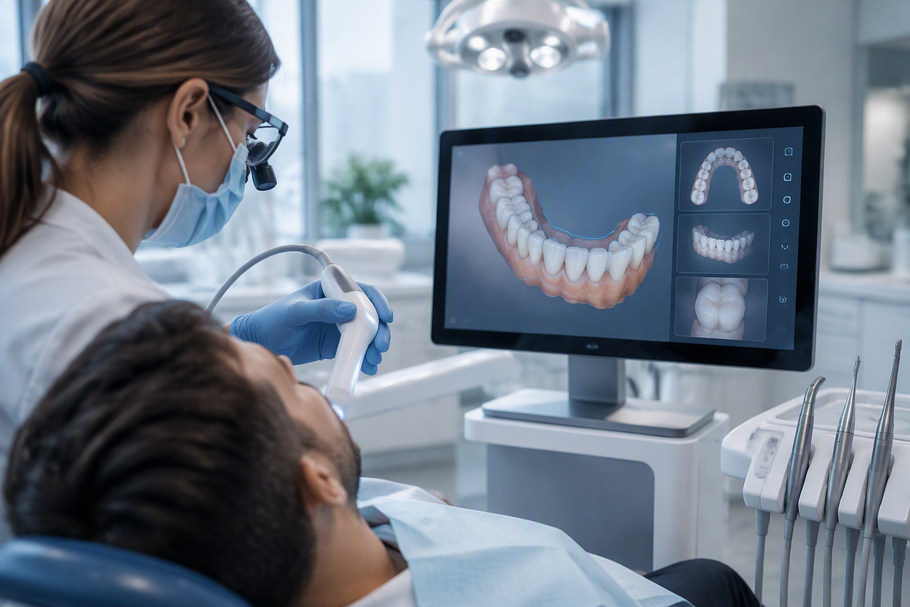
Administrative automation has probably advanced the fastest. AI receptionists, automated recall systems, insurance verification, and no-show prediction are enabling practices to reduce time spent on routine administration and make better use of the diary. Diagnostics have progressed quickly, too. AI-assisted reading of radiographs and CBCT scans, caries detection and treatment planning support are becoming increasingly common. Then there's the patient journey side of things, with AI-generated smile simulations and automated communications helping keep patients engaged throughout treatment.
Most of this is delivering real benefits. The technology is improving, adoption is growing, and practices are genuinely becoming more efficient.
But here's the part I don't think we're talking about enough. I look at practice financials for a living. Valuations, transactions, sustainable earnings, guide prices – I spend my days understanding what makes a dental business valuable. Looking across the deals I'm involved in and the conversations I'm having throughout the sector, one thing stands out: the efficiency gains we're hearing about aren't yet showing up consistently in EBITDA margins.
That's not because the technology doesn't work; far from it, in fact. In many cases, the efficiencies are real. Admin time is coming down, workflows are improving, and capacity is being created, but when you get to the bottom line, the impact is often far less obvious than the headlines would suggest.
The reason is straightforward: most practices implementing AI today are still in the investment phase. There are software costs, training requirements and the inevitable disruption that comes with introducing new systems and ways of working. The benefits may be there, but in many cases, they're being absorbed rather than banked.
This becomes particularly important when valuation discussions start. A practice owner might tell me their AI-powered scheduling system has reduced no-shows and freed up time in the diary. That's a positive story and absolutely worth highlighting, but the next question is always the same: what happened next? Did that additional capacity generate more appointments? Did it lead to a higher-value treatment mix? Did it reduce costs as a proportion of revenue? Did it improve profitability? Ultimately, that's what buyers are looking for.
The point I'm making isn't that practices should slow down on AI, if anything, I'd argue the opposite. The direction of travel is clear, and the businesses that embrace useful technology will be better positioned over the long term than those that don't. What matters, however, is having a plan for the capacity and opportunities that AI creates.
If AI frees up 20 minutes of chair time a day, that only has value if it's filled with another patient or a higher-value treatment. If AI diagnostics identify more restorative needs earlier, that only has value if those opportunities are converted into treatment. If automation reduces administrative workload, that only has value if the practice finds a way to capture the resulting efficiency.
Put simply, practices need to fill the white space; that's where the commercial benefit lies.
Over the next few years, I suspect the practices achieving the strongest valuation multiples will not necessarily be those with the most extensive AI adoption. They'll be the ones who can clearly demonstrate what those tools have delivered. Not “we implemented X, Y and Z” but “here's what happened to our EBITDA.”
At the moment, much of the discussion around AI is focused on capability, which is understandable because the technology is moving quickly and there's a lot to be excited about. From a business and valuation perspective, capability is only part of the story, and conversion matters just as much.
We're not quite there yet as a sector, and I think it's worth saying that openly. Not as a criticism of AI, but as a reminder that efficiency only creates value when it's translated into revenue growth, cost savings or improved profitability. The technology is doing its job. The commercial discipline required to capture the benefit is the part that still needs to catch up.
To discuss your dental business in more detail, get in touch with Paul Graham: paul.graham@christie.com or 07739 876 621