
Five key takeaways from Christie & Co's Nordics Hotel Market Snapshot 2026
In this blog post, Pierre Ricord (Head of Consultancy - Hotels at Christie & Co) summarises his key takeaways from the company's 'Hotel Market Snapshot: Nordics' report which analyses the hotel market across Finland, Sweden, Norway, Denmark, and Iceland.
Business. Built around You.
Your expert business property advisers

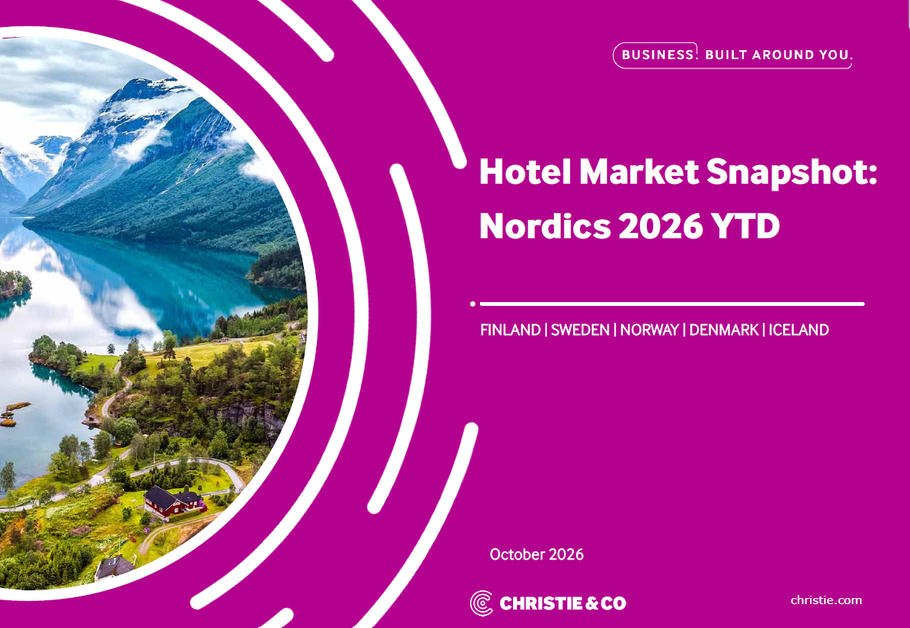
The Nordic hotel market continues to attract attention from owners, operators, developers, and investors alike. Strong tourism demand, a growing international profile, and resilient economic fundamentals are helping support performance across the region, although the five countries continue to show distinct characteristics and investment opportunities.
Drawing on our latest Nordics Hotel Market Snapshot report, here are five key themes shaping the Nordic hospitality market today.
1. THE NORDICS ARE BENEFITING FROM CHANGING TRAVEL TRENDS
The region's reputation for quality, sustainability, outdoor experiences, and well-connected cities continues to underpin tourism growth. One of the most notable emerging trends is the rise of ‘coolcation’ travel, as visitors increasingly seek cooler climates and nature-led destinations during the summer months. This trend could help broaden the Nordics’ international appeal and support demand growth beyond traditional source markets.
At the same time, international tourism continues to recover, while economic conditions across the region are becoming more stable, creating a more favourable backdrop for hotel trading and investment.
2. STRONG TOURISM FUNDAMENTALS
While leisure demand is a major driver throughout the region, each Nordic market has its own demand profile. Denmark and Sweden are particularly leisure-led, while Norway and Iceland benefit from a more balanced mix of leisure and business travel. Finland, Norway, and Sweden also benefit from substantial domestic tourism, which provides resilience during periods of international travel disruption.
Sweden generated the highest inbound tourism expenditure in 2025 at €11.9 billion, while Iceland recorded the highest spend per visit at €1,772, highlighting the differing value dynamics across the region.
For hotel operators, this means domestic demand remains a key occupancy driver in several markets, while Iceland and Denmark offer greater opportunities to capitalise on international visitor spending.
3. HIGH GROWTH ACROSS SELECT NORDIC HOTEL MARKETS
The Nordic hotel sector has largely moved beyond the post-pandemic recovery phase, although performance levels remain uneven across markets. On a country level, Iceland is the standout performer, recording the strongest RevPAR growth in the region and maintaining the highest absolute RevPAR levels. Norway continues to perform strongly, while Denmark, Sweden, and Finland remain above their 2019 benchmarks.
August 2026 YTD data showed that Iceland was the strongest-performing market with a RevPAR index of 1.75, followed by Norway at 1.55. Iceland also achieved the highest absolute RevPAR at €247.5. Notably, RevPAR growth across all five countries has been driven primarily by ADR, demonstrating operators’ ability to maintain pricing power despite changing market conditions.
On a city level, Copenhagen was the region’s fastest-growing urban hotel market, recording RevPAR growth of 7% year-on-year in 2026 YTD, as highlighted at the NHC Conference.
RevPAR Index* (FY 2019 = 1.00, August YTD 2019 = 1.00)
4. OPERATING FUNDAMENTALS REMAIN COMPETITIVE
The Nordics continue to present a mixed but generally competitive operating environment. Labour costs are higher than in many European markets, but these are partially offset by comparatively lower utility costs.
Amongst its peers, Finland offers the most favourable operating-cost environment, benefiting from lower wage levels and electricity costs, while Norway offers a balanced position with relatively low utility costs and moderate employer contributions. Denmark and Sweden face different cost challenges, while Iceland combines favourable energy costs with higher wage pressures. For investors and operators evaluating expansion opportunities, structural differences and operational implications remain critical when assessing long-term profitability.
5. INVESTOR INTEREST REMAINS STRONG DESPITE SLOWER TRANSACTION ACTIVITY
Although transaction volumes slowed during the first half of 2026 compared with the exceptionally strong levels seen in 2025, investor interest in the region remains, with Nordic hotel transaction volumes reaching approximately €1.9 billion in 2025 before easing to €369 million in H1 2026.
Sweden is the region's most active investment market, accounting for 41% of total 2025 transaction volume, followed by Denmark at 33% and Norway at 20%.
At the same time, the market's fragmented independent hotel sector presents opportunities for consolidation, brand conversion, and further professionalisation. Independent hotels account for 65% of properties across the Nordics, suggesting significant potential for operators and brands seeking growth opportunities.
MARKET OUTLOOK
The Nordic hotel market enters the final months of 2026 from a position of strength, with stable economic conditions, resilient tourism demand, growing international visibility, and continued investor interest all supporting a positive long-term outlook. While performance, operating costs, and investment dynamics vary across the individual markets, the Nordics continue to offer a diverse range of opportunities for hotel owners, operators, developers, and investors.
As such, the region is continuing to attract investment and expansion interest. Most recently, the partnership announced by Scandic and Hilton provides further evidence of confidence among major operators and international brands in the long-term prospects of the Nordics hotel market and its potential for further diversification of its hotel offering.
To find out more about the hotel market in the Nordics, read our latest report here.