
Reading the market in 2026: What hotel deals reveal
We recently attended the Annual Hospitality Conference in Manchester, where our Managing Director – Hotels & International, Carine Bonnejean, presented a session reflecting on the year's most significant hotel transactions, where capital is flowing, which assets are attracting demand, and how buyers and sellers are pricing risk in today's environment.
Business. Built around You.
Your expert business property advisers

Carine Bonnejean
Managing Director – Hotels & International
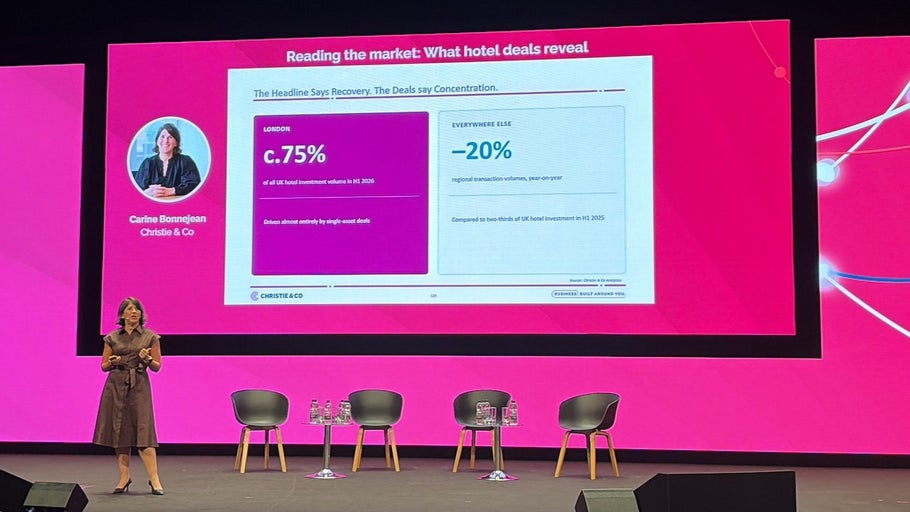
While sentiment surveys and economic forecasts can offer useful context, examining the transactions that have completed this year can reveal how investors are really thinking about hotels today.
The recovery is real, but highly concentrated
More than £2.5 billion was invested in UK hotels during the first half of 2026, around 70% more than in the same period last year. On paper, this looks like a strong recovery, particularly given the geopolitical uncertainty and tariff-related volatility that disrupted investor confidence and slowed capital deployment at the start of the year.
However, the total tells us how much capital moved, not how widely it moved - so, let’s look beneath this headline number.
A closer look shows that this recovery has been driven by a relatively small number of large transactions. London accounted for almost 75% of all UK hotel investment volume in the first half of the year, driven largely by a small number of major single-asset transactions. Last year, two-thirds of UK hotel investment happened outside London - this year, almost three-quarters happened inside London.
Meanwhile, regional investment volumes are down 20% year-on-year. However, this doesn't mean investors have lost interest in regional hotels - quite the opposite. Capital remains active, but it has become much more selective. So far this year, we have advised on almost 70 hotel sales, including 11 transactions completed in the last 11 days alone, demonstrating that well-positioned assets continue to attract strong buyer interest across the UK.
Investors are focusing on assets with strong trading fundamentals, attractive yield profiles, and clear demand drivers. We continue to see strong interest in markets such as Edinburgh, Manchester, Oxford, York, Glasgow and Liverpool.
Rather than one UK hotel investment market, what we're seeing today is two very different markets operating at the same time. And that brings us to the key question: what is actually driving this headline recovery?
Conviction is driving capital allocation
The answer is a relatively small number of very large transactions. In fact, ten deals above £100 million accounted for approximately £1.7 billion of investment volume in the first half of the year – two-thirds of all UK hotel investment volume.
The largest transactions completed in 2026 have predominantly involved high-profile assets in prime locations, where investors have confidence in long-term demand, liquidity and value creation potential. At the same time, private buyers and owner-operators remain active in smaller cash-flow driven transactions. New buyers are also emerging in this space, like care home operators, driven by operational synergies, diversification and a far less regulated environment.
The quieter part of the market sits in the middle, where pricing expectations, financing conditions, and future capex requirements are still creating hesitation. The market seems happy to buy a £100 million-plus trophy asset. It's also happy to buy a 30-bedroom regional hotel. The harder trade today is the regional portfolio or mid-sized platform where buyers need a very clear value-creation story.
The challenge in today's market is not finding capital, but finding assets that give investors sufficient conviction to deploy it. Buyers remain highly engaged, where assets can demonstrate resilient earnings, clear positioning and identifiable growth opportunities, competitive bidding remains common.
The investment question has changed
Macroeconomic conditions have undoubtedly improved compared with previous years. Debt markets have become more competitive, and financing is more readily available than it was 12 months ago.
However, investors remain mindful of a number of ongoing pressures, including labour costs, National Insurance, pressure on margins, future capex and PIPs, compliance and FLS and refinancing risk. The recent rise in UK inflation to 3.1% serves as a reminder that economic uncertainty has not disappeared and that cost pressures remain a key consideration for investors. Additionally, the recent US interest rate increase adds a new dimension to the market outlook, with higher borrowing costs potentially leading to further caution for some investors.
As a result, the investment discussion has shifted. It is no longer simply “Can revenue grow?” It is “Can profits be protected?” Capital has not disappeared, but it has become more demanding. Traditional investment cycles are now less predictable, with geopolitical and economic events increasingly disrupting their established patterns.
What could unlock the next wave of transactions?
Looking ahead, several factors are likely to determine the pace and breadth of future deal activity:
- Motivation - refinancing, capital expenditure requirements, and ownership cycles need to create genuine reasons to sell
- Pricing - yield expectations are beginning to stabilise, but buyers and sellers still need to align on earnings, future capital expenditure and risk
- Debt - lending conditions are becoming more competitive, but broader activity depends on finance reaching the middle of the market, not only prime assets
So, three key takeaways to remember:
- London is carrying the headline volume
- The middle of the market is still missing
- Cash-flow quality is the new currency
The headline recovery is real, but it is concentrated, and the winners will be those who can prove why their asset deserves conviction.
For more insights on the hotel market, or for confidential advice about your hotel business, contact: